

The Bionic Man has not arrived, and to our knowledge the military has not equipped any special agents with cyborg implants to boost their optical capabilities in the field. No, the news is both less and more exciting than those fantasy scenarios: people with end-stage age-related macular degeneration (AMD) now have the chance to see again. Surgeons and vision scientists at the University of California Davis Eye Center in Sacramento recently celebrated their first successful procedure with the new technology. The medical duo that performed the operation were Drs. Mark Mannis and Jennifer Li.
Read More
0 Comments Click here to read/write comments
Tags: CA, University of California Davis, Optics, Southwest, California, 2012, BioResearch Product Faire Event, Davis, Sacramento Campus, UCD
 Researchers trying to find ways to help cure children of disease before they are born with it face an uphill challenge, in part because research on human embryos (even research that might result in a human embryo) is limited by the federal government when federal funding is at issue. Yet progress is being made, notably in the case of mitochondrial diseases passed from mother to child. A gene therapy procedure being studied and tested at Oregon Health Sciences University puts the nucleus of an egg cell with the mother's DNA into the scooped-out mitochondrial shell of another, healthier woman's egg cell. Then the egg is fertilized in vitro and gestated in utero. When research on nonhuman primates three years ago was a success (the monkeys are all alive and well), they tested the basic steps of the procedure with donated human eggs. They brought the hybrid eggs to the blastocyst stage, then cultured lines and did testing on them. At least 20% of the fertilized samples would have been viable for placement in utero.
0 Comments Click here to read/write comments
Tags: Oregon Health Sciences University, Northwest, gene therapy, Oregon, 2012, scientific research, Cell Research, BioResearch Product Faire Front Line Event, OR, OHSU, Portland
Science researchers at the University of North Carolina at Chapel Hill recently conducted a study that shows that boys in the United States are entering into puberty earlier than in the past, sometimes as young as at the age of nine, according to a UNC Chapel Hill news article. The research was published online in the journal Pediatrics and presented on October 20th at an American Academy of Pediatrics (AAP) conference and exhibition in New Orleans.
0 Comments Click here to read/write comments
Tags: University of North Carolina, 2012, Southern, BioResearch Product Faire Front Line Event, NC, science researcher, public health, Chapel Hill, UNC
Though the general consensus seems to be that the Northeast weathered deadly storm Sandy relatively well thanks to warnings and emergency plans put into action, there were unexpected casualties beyond the loss of over 80 human lives. Massive flooding in the lower New York Metro Area was not on the radar to the extent that it actually transpired, and basements that were thought to be flood-safe turned out not to be. That was the case at New York University's Smilow Research Center, where animal labs underground were inundated and approximately 10,000 research mice and rats drowned and lab equipment was ruined. On the upper floors, precious biological samples and reagents were lost as freezers and refrigerators shut down. Other research institutions in the area fared better.
0 Comments Click here to read/write comments
Tags: Mount Sinai School of Medicine, Rockefeller University, Northeast, animal research, research mice, University of Texas, New York, 2012, Stony Brook University, Austin, Philadelphia, MSSM, BioResearch Product Faire Event, NY, Front Line event, science research, research laboratories, New York City, Research equipment, Stoneybrook
When a catastrophic natural disaster strikes, first responders often make the difference between life and death for potential victims. Training, preparedness and valor play a part in successful rescue efforts, but so do good tools. Sometimes that tool is as basic as an axe or a flashlight, or a life vest or life raft. The recent mega-storm in the NE has us thinking about the kinds of tools that science research is coming up with to address emergency and crisis situations, both during and in the aftermath of a major event. To that end, we're taking a look back today at some of our earlier blogs on life science research invention to see what kinds of scientific solutions are on the horizon (or already here) to aid in disaster relief and recovery efforts.
0 Comments Click here to read/write comments
Tags: UW, Ozcan Nano/Bio Photonics Lab, University of Washington, WSU, University of Minnesota Twin Cities, 2012, Los Angeles, Colorado State University Fort Collins, BioResearch Product Faire Event, UCLA, Front Line event, Seattle, Biotechnology Vendor Showcase, Colorado, St.Paul, scientist solutions, CSUFC, disaster relief
Often growing up as a child you hear, “eat your veggies if you want to grow up to be big and strong.” With new research on triple negative breast cancer, that old saying might have to change to "eat your veggies if you want to keep cancer away". Recently, at the 2012 American Association of Pharmaceutical Scientists (AAPS) Annual Meeting, Mandip Sachdeva announced: "We are confident that the compounds we are currently working with are an effective treatment for triple-negative breast cancer. These compounds are safer for the patient than current treatments available".
9 Comments Click here to read/write comments
Tags: Bioscience research, cancer research, Texas A&M University, Texas, 2012, Cancer Treatment, Cancer, College Station, BioResearch Product Faire Event, Texas A&M Research, Texas A&M Life Science Funding, TX, Texas A&M
An ingredient of traditional Chinese medicine is making a modern appearance in the treatment of pancreatic cancer. It’s called the Thunder God Vine, and it has been used in teas and traditional medicine for a long time. In recent years, it’s been making a name for itself in the treatment of rheumatoid arthritis. Now, researchers at the University of Minnesota have discovered Thunder God Vine’s surprising potency against pancreatic cancer.
1 Comment Click here to read/write comments
Tags: Midwest, University of Minnesota, Minnesota, Minneapolis, MN
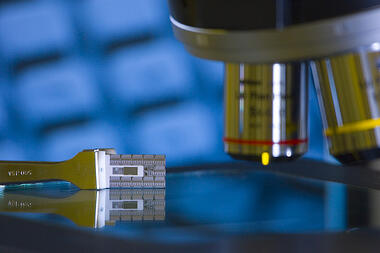 One of the ways to measure how well a program or department at a university is doing is to look at their graduate programs. To be able to offer the PhD in a specialized area, you need qualified faculty willing and able to take on teaching and mentoring responsibilities; a strong reputation for excellence in the area; research opportunities (and RA funding) for those doctoral students; and equipment and laboratory facilities, to name just a few factors. So when you see an institution win a major grant to launch a PhD program, you know that's a hot area for research and facilities expansion as well.
0 Comments Click here to read/write comments
Tags: CA, biomedical research, Photonics, University of California Irvine, Southwest, California, 2012, BioResearch Product Faire Event, Funding, Irvine
Michigan State University at East Lansing is priming plants to cope with two very different adversaries: hostile insects on Earth and the stressful conditions of space. Rather than furnishing them with armor or a spacesuit, researchers are working at the molecular level in order to make these plants more genetically hardy.
1 Comment Click here to read/write comments
Tags: Michigan State University, Midwest, 2012, Michigan, Plant science, MI, Front Line event, East Lansing
Oregon State University in Corvallis is the state's leading public research institution and has recently announced that the 2011 fiscal year ending in June was its 2nd best ever for overall research funding levels (the prior year being #1 by a hair). In fact, 2011 was OSU's top year for private sector funding, at $35M, which inclulded payments for testing services, environmental analysis, prototype development and licensing fees. That figure represents a 42% increase over 2 years. Alll in all, Oregon State counted $261.7M in external funding in the 2011 fiscal year.
0 Comments Click here to read/write comments
Tags: Oregon State University, Northwest, Oregon, 2012, Funding, Front Line event, marine science, OR, Corvallis, NSF, ORSTU