

 Researchers around the world are constantly studying ways to create new treatment methods to fight cancer. With so many different forms of cancer, using one treatment method is not always effective for everyone battling this disease. Recently, a team of scientists in Chicago teamed up to create a new treatment method. Researchers from the University of Chicago and the biotechnology company Evelo Biosciences have partnered to develop a new microbiome-based immunotherapy treatment method for fighting cancer.
0 Comments Click here to read/write comments
Tags: Midwest, microbiome, immunotherapy, University of Chicago, cancer research, Chicago, Front Line event, IL, UChicago, 2016, BioResearch Product Faire, cancer therapy, Evelo Biosciences, microbiome immunotherapy

(1886 Sketch of Person with Parkinson's by Sir William Richard Gowers Courtesy of Wikimedia Commons)
Researchers at the University of Alabama, Birmingham have discovered a potential new approach to reducing the damage done by Parkinson's disease. They found that suppressing a key cell-signaling pathway in the brain lessened the destructive inflammation and nerve degradation in the area of the brain affected by Parkinson’s. In the study, rats were used to model the disease by inducing an overexpression of a-synuclein, a protein that is abundant in the human brain. The accumulation of α-synuclein is a core feature of Parkinson’s disease. This accumulation leads to the activation of the brain's immune cells and the production of inflammatory signaling chemicals, which leads to neurodegradation. The rats that were then given a JAK/STAT pathway inhibitors (known as Jakinibs) did not have the immune response, the inflammatory activation, or the neurodegeneration that those that did not receive the inhibitor experienced.
Read More
0 Comments Click here to read/write comments
Tags: Parkinson's Disease Research, Alabama, University of Alabama, University of Alabama Birmingham, UAlab, Birmingham, AL, University of Alabama at Birmingham, 2016, Parkinson's Disease
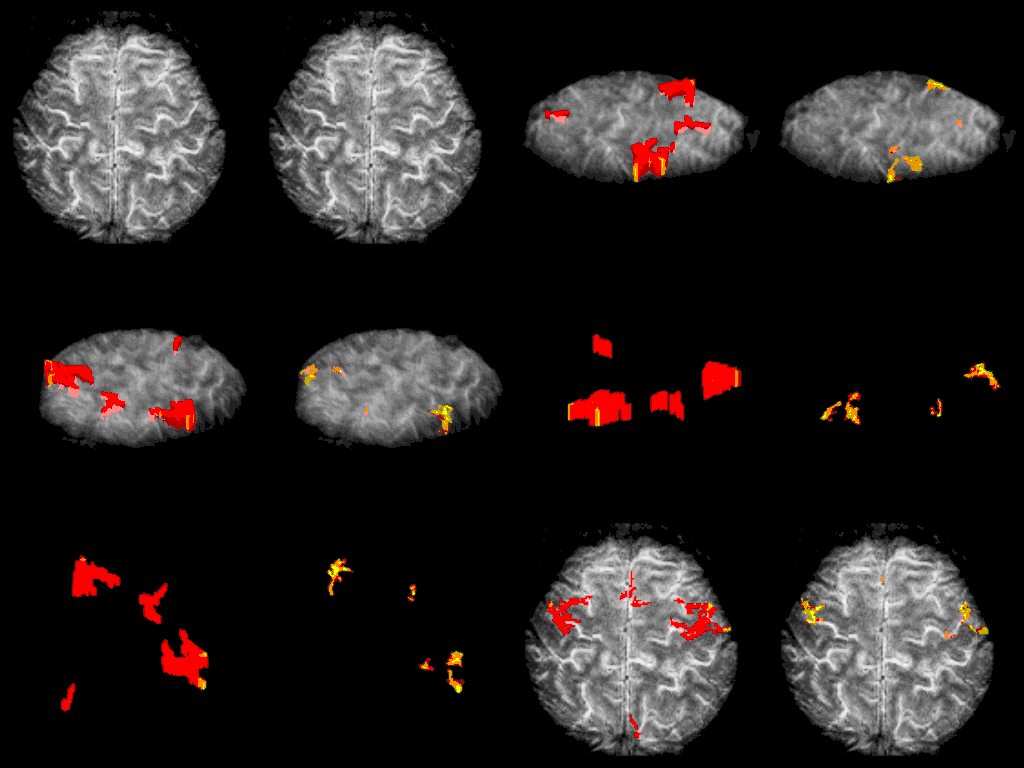
(Image of brain by functional MRI via Wikimedia Commons)
Cognitive neurologist, Rosie Cowell of the University of Massachusetts, Amherst received a nearly $600,000 grant from the National Science Foundation. The funding will be used to develop and test her theory of how fine-grained visual perception interacts with the area of the brain critical to memory.
Read More
0 Comments Click here to read/write comments
Tags: University of Massachusetts Amherst, University of Massachusetts, Bioresearch event, brain research, MA, research grant, Amherst, UMASS, Bioreseach, 2016, fMRI, Rosie Cowell
 Neuroscience and genetics are two important topics life scientists are consistently studying. Researchers from UC Davis found a promising treatment for Huntington's Disease, while UC San Francisco was awarded $185 million to build a new neuroscience research institute. Recently on the East Coast, a team of researchers from the Columbia University Medical Center discovered a new neurodevelopmental syndrome as well as the genetic makeup of the mutations that cause the syndrome. (Image courtesy of Allen Ajifo via Wikimedia Commons)
0 Comments Click here to read/write comments
Tags: Northeast, Columbia University, Neuroscience, Columbia, Genetics, Neurology, NY, Columbia University Medical Center, 2016, BioResearch Product Faire, neurodevelopmental syndrome
Q fever, an infectious disease caused by the bacteria Coxiella burnetii, is common among livestock such as cattle, sheep and goats. The bacteria can be transmitted to humans through the inhalation of barnyard dust that is contaminated with animal excretion containing the bacteria. Along with passing from livestock to humans, Q fever has been aerosolized in the past and used for biological warfare.

(Image Courtest of Wikimedia Commons and the National Institutes of Health)
Read More
0 Comments Click here to read/write comments
Tags: CA, vaccine research, infectious diseases, NIH funding, UCI, UC Irvine, 2016, BioResearch Product Faire, Western, Coxiella burnetii, Q Fever
A pioneering new study at Ohio State University found a link between chronic stress and short-term memory issues. In the study, mice were subjected to repeated visits from an aggressive, larger intruder mouse. Researchers found that the mice repeatedly exposed to the intruder had more difficulty recalling where the escape hole was in a maze they’d mastered prior to the stressful period, compared to mice that had not been stressed.

(Image Courtesty of Wikimedia Commons and Maria Rimmel)
Read More
0 Comments Click here to read/write comments
Tags: Ohio State University, Ohio State, Ohio State University life science research, brain research, Ohio State life science, Ohio State life science research, Biotechnology Vendor Fair, Ohio State University life science, Columbus, OH, OhStu, stress, 2016, Dr. Godbout, memory loss
Bacteria research has become an increasingly important focus for researchers in the biomedical community as of late. From studying antibiotic resistant superbugs at UCSD to investigating bacterial diversity at Rutgers University, researchers are using these microscopic organisms to provide insight into diseases that plague our society.
Read More
0 Comments Click here to read/write comments
Tags: University of Massachusetts Amherst, Massachusetts, MA, UMASS, Bacteria, Bacterial Cell Research
0 Comments Click here to read/write comments
Tags: Michigan State University, Midwest, BioResearch Product Faire Event, MI, East Lansing, MSU, new Building, new funding, 2016, Grand Rapids Research Center
 It is well known that infants rely on their mothers for food and nutrients in their early years. However, the effect that the hormones in this food have on an infant's development has not previously been known. Recent research conducted at the University of Colorado, Anschutz Medical Center has shown that hormones in human breast milk contribute to the health of the feeding infant. (Image by Voiceboks via Wikimedia Commons)
0 Comments Click here to read/write comments
Tags: University of Colorado, Anschutz Medical Campus, CO, Fitz, Aurora, 2016, BioResearch Product Faire, Western, gut bacteria, Gammaproteobacteria, Breast milk
(Original article from 2013 by Jennifer Niuwkerk. Updated information added by Jennifer Winstead.)
Are you a researcher, lab manager, post-doc or purchasing agent interested in networking with colleagues and learning about the latest lab equipment and services on the market at the Universtity of California, Davis Medical Center?
UPDATE: If so, make sure you don’t miss Biotechnology Calendar, Inc.’s Sacramento BioResearch Product Faire™ Event on June 7, 2016. Lab supply companies are eager to meet researchers at this event and discuss with you your research goals. If you are facing problems in the lab, the sales reps at our UC Davis Medical Center show may be able to recommend viable life science solutions.
1 Comment Click here to read/write comments
Tags: CA, Southwest, California, UCDMC, BioResearch Product Faire Event, Sacramento, UC Davis - Medical Center, researcher invite, life science events, meet researchers, 2016