

For the 2016 fiscal year budget, and Congress increased government funding on research for Alzheimer's by $350 million. That was a 50% increase over the previous year. The Alzheimer’s Association estimates that the National Institutes of Health would need $2 billion a year to maximize the chances of curing or preventing the disease by 2025. This year’s increase puts the NIH on track to reach that goal. Alzheimer's Disease is the most common form of dementia and this increased science research funding it is already beginning to pay off.
Read More
0 Comments Click here to read/write comments
Tags: biomedical sciences, Bioresearch funding, Alzheimer's Research, Alzheimer' Research, Rutgers University, Rutgers, BioResearch Product Faire, dementia research, Biotechnology trade show
When it comes to research the University of Minnesota has a lot going for it. Their 4,000 faculty include members of the National Academy of Sciences, the National Academy of Engineering, and the Institute of Medicine, as well as the American Academy of Arts and Sciences. U of M ranks 8th among public universities in research spending, with more than $870 million spent annually. In 2016, over $243M of that research funding was awarded by the National Institute of Health.
Read More
0 Comments Click here to read/write comments
Tags: sell lab equipment, University of Minnesota Twin Cities, UMinn, Lab Product Sales, BioResearch Product Faire, uminn research, NIH awards 2017

Dr. Robert Darnell, Professor of Cancer Biology and Head of the Laboratory of Molecular Neuro-Oncology at Rockefeller University, received a $1.1 million grant from the NIH’s National Institute of Neurological Disorders and Stroke.
This research funding will support his lab’s new approach to studying diseases of the brain through modern biotech services and more efficient informatics. He and his lab will work on harnessing the power of molecular biology to define therapeutic targets for several different types of brain diseases. Researchers will do this by combining the latest technological advances modern science has brought to neuroscience with new computational approaches.
Read More
0 Comments Click here to read/write comments
Tags: Rockefeller University, RockU, Research Funding, Life Sciences, life science researchers, Biomedical Research Funding, BioResearch Product Faire, Biotechnology trade show, biotech services
The Institute for Applied Life Sciences (IALS) at University of Massachusetts, Amherst is now fully operational and open for use by UMass faculty researchers as well as its industry and academic partners.
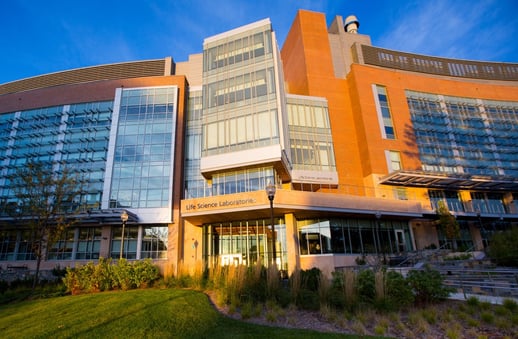
(Image Courtesy of University of Massachusetts, Amherst)
The institute was first established in 2014 through a $95 million grant from the Massachusetts Life Sciences Center (MLSC). Mass invested an additional $55 million in toward the construction and fit-out of the Life Sciences Laboratories building. This building is designed for interdisciplinary research, student training and large-equipment facilities. IALS also fosters spin-out companies and seeks to become a catalyst for a biotechnology hub in Western Massachusetts.
Read More
20 Comments Click here to read/write comments
Tags: University of Massachusetts Amherst, life sciece markets, Life Science, Amherst, UMASS, life science labs, life science institute
Thus far in 2017, the University of California Los Angeles has received over $6.8 million in funding from the National Heart Lung and Blood Institute (NHLBI). This funding has been awarded through multiple grants intended to support cardiovascular research.
Read More
0 Comments Click here to read/write comments
Tags: University of California Los Angeles, cardiovascular research, increase laboratory product sales, UCLA, NIH funding, life science research at UCLA, life science solutions, science solutions, NIH awards 2017
The National Institute of Health (NIH) awarded Washington University in St. Louis over $1.4 million in grant funding to support their School of Medicine’s Diabetic Research Center. This award was administered through the National Institute of Diabetes and Digestive and Kidney Diseases (NIDDK) as it has been for the last 38 years. The funding will help support the Diabetic Research Center (DRC) and their life science labs. The DRC's mission is to “support and enhance research in diabetes and related metabolic diseases” through Biomedical Research Core services as well as the Pilot and Feasibility Program.
Read More
0 Comments Click here to read/write comments
Tags: Washington University St. Louis, Bioresearch funding, Biotechnology vendor show, Washington University, WUSTL, Diabetes, NIH award, life scinece, life science labs, Biotechnology trade show
The California Institute for Regenerative Medicine (CIRM) awarded two scientists at UC San Diego $2 million each for their innovative research. The first award went to Alysson R. Muotri, PhD, professor in the UC San Diego School of Medicine departments of Pediatrics and Cellular and Molecular Medicine. The funding will support studies of new treatments for Zika. The second award went to Dan Kaufman, MD, PhD, professor of medicine in the Division of Regenerative Medicine. This funding will support the creation an “off-the-shelf immunotherapy” using NK cells to treat refractory or resistant tumors, such as ovarian cancer.
Read More
0 Comments Click here to read/write comments
Tags: Bioresearch funding, Cancer Treatment, Cancer, Biotechnology Vendor Fair, UCSD, UC San Diego, CIRM, research grants, zika, Biotechnology trade show
The National Institute of Health (NIH) awarded the University of Georgia a $2.27 Million grant to study a powerful gene editing tool known as CRISPR-Cas. In nature, CRISPR-Cas is a defense mechanism that single-celled organisms such as bacteria use to ward off attacks from viruses and other invaders. For scientists the CISPR-Cas9 system holds a potential tool to edit precise sequences of DNA and silence the genes that predispose some people to diseases such as cancer, diabetes, cardiovascular disorders and mental illness.
Read More
0 Comments Click here to read/write comments
Tags: biomedical research, University of Georgia Athens, University of Georgia, DNA Research, UGA, Biotechnology Vendor Fair, Biotechnology trade show
18th Annual
Read More
0 Comments Click here to read/write comments
Researchers at UCLA believe using the patient’s own cells to create stem cells for therapeutic purposes is the future of medicine. A recently published study by scientists at UCLA demonstrates how specialized proteins change the cellular characteristics of skin cells to create induced pluripotent stem cells. These stem cells have the ability to turn into any cell type within the body. Also at UCLA, a clinical trial which uses the baby’s own blood-forming stem cells to treat the immune deficiency condition ADA-SCID, better known as “bubble baby disease,” was recently awarded a $20M grant from the California Institute for Regenerative Medicine.
Read More
0 Comments Click here to read/write comments
Tags: University of California Los Angeles, Stem cell research, Human Stem Cell, UCLA, Stem Cell, biotech vendor show, Biotechnology trade show