

The University of Alabama at Birmingham has been awarded a $7 million research grant to continue its leadership in pioneering clinical trials in the treatment of neurofibromatosis 1 and 2 and schwannomatosis, all rare genetic diseases. According to the Birmingham Business Journal, the circumstances of these diseases lead to non-cancerous tumors forming on the nerves and potentially causing blindness, hearing loss, learning disabilities, pain or deformity.
Read More
0 Comments Click here to read/write comments
Tags: 2012, Alabama, University of Alabama, University of Alabama Birmingham, BioResearch Product Faire Event, UAB, Birmingham, AL, research grant
Biomedical science researchers have worked tirelessly at the University of California, Riverside since the discovery of a crucial link involving mice, humans, and Alzheimer's disease. Back in 2006, UCR researchers, in a collaborative effort with the University of South Florida, discovered an interesting connection between the immune system and Alzheimer's disease while experimenting on lab mice. Professor Douglas Ethell, the assistant professor of Biomedical Sciences at UCR, along with the USF's own Professor Gary Arendash of the Johnnie B. Byrd Institute, was instrumental in this find.
1 Comment Click here to read/write comments
Tags: CA, Bioscience research, biomedical sciences, biomedical research, Bioresearch, Southwest, 2012, Alzheimer' Research, BioResearch Product Faire Event, Research, Riverside, UC Riverside, UCR
New research at Texas Medical Center is underway at the newly opened Neurological Sleep Medicine Center in the Memorial Hermann Hospital. This progress is taking place amidst the tireless construction and restless activity of downtown Houston.
0 Comments Click here to read/write comments
Tags: Bioresearch, Texas Medical Center, Texas, 2012, tmc, BioResearch Product Faire Event, Houston, TX, TMC New Research Facilities
How is it that a prominent Rockefeller University professor and director of the Laboratory of Neurogenetics and Behavior is sought out by a fashion magazine one month, the New York Magazine the next, and a CBS interview just last week? Dr. Leslie Vosshall studies the mechanism of scent recognition in humans on the one hand, and attraction to humans by mosquitos on the other. We still know so little about smell, and even less about why an insect like the mosquito hones in on one of us more often than another, but the Vosshall Lab is adding insight to the genetic basis of olfactory recognition. Given that mosquitos are a global vector for disease, including right here in the U.S., Vosshall's research aims to find out what it is about a particular one of us that excites the little bug to such raptures. If we know that, perhaps we can intervene productively to keep them at bay. As for the fashion magazine (Elle Canada), they wanted an expert on scent to comment on designers' and retailers' new fad for marketing their products with a scent component.
4 Comments Click here to read/write comments
Tags: Rockefeller University, Northeast, women in science, New York, 2012, genetic engineering, Neuroscience, BioResearch Product Faire Event, NY, New York City
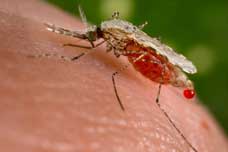 It's summer in the Northern Hemisphere, and in most places that means mosquitos are out for our blood, which wouldn't be much to give up if it weren't for the itchy -- and in many parts of the world, deadly -- package that the tiny insect leaves behind. Plasmodium falciparum is the human malaria pathogen that kills over a million people annually around the world (largely infants, young children and pregnant women, most of them in Africa). One approach to combatting the spread of the disease is to genetically engineer a mosquito that cannot transmit the parasite and yet is able to reproduce with mosquitos that do, in order to infiltrate and alter the population overall to become one that is benign (except for the itching).
0 Comments Click here to read/write comments
Tags: CA, University of California Irvine, Southwest, California, 2012, genetic engineering, BioResearch Product Faire Event, Irvine, UCI

ARCHITECT'S RENDERING OF NEW PROTON BEAM THERAPY FACILITY IN ROCHESTER, MINN.(Courtesy of mayoclinic.org)
3 Comments Click here to read/write comments
Tags: Minnesota, 2012, Rochester, Mayo Clinic, Cancer Treatment, Cancer, BioResearch Product Faire Event, MI, Proton, Treatment
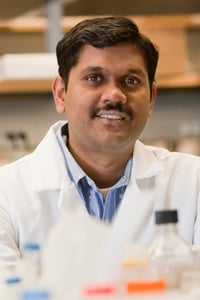 The first construction of an image by Nuclear Magnetic Resonance (NMRI) by Dr. Paul Lauterbur took place at the University at Stony Brook thirty years ago, and the Stony Brook Chemistry professor went on to win the 2003 Nobel Prize for his work. So it's fitting that another breakthrough in MRI technology is also taking place at the Long Island research university, this time by biomedical engineer Balaji Sitharaman, right, and his team, who have developed a potentially safer and more cost effective MRI contrast agent for improved disease diagnosis and detection. The agent is graphene-based rather than gadolinium-based, and the success of the advanced agent is documented in a recent PLoS ONE article.
2 Comments Click here to read/write comments
Tags: biomedical sciences, biomedical research, Northeast, New York, Stony Brook University, venture development in life sciences, BioResearch Product Faire Event, Biomedical Research Funding, scientist solutions, life science products, science solution
 University of Cincinnati College of Medicine molecular geneticist Daniel Hassett (right) has made a name for himself as a determined researcher in the fight against cystic fibrosis (CF). He is also on the front line of bioscience research into creating "superbugs" that eat waste and generate energy, improving dramatically on the efficiency of traditional waste water treatment systems. In a radio interview on WVXU Cincinnati's Focus on Technology, commentator Ann Thompson describes the problem: the largest user of energy is wastewater treatment; the second largest user of water is energy production. If you can find a way to both clean water and generate electricity, you're in business.
0 Comments Click here to read/write comments
Tags: Bioscience research, Midwest, Ohio, biomedical research, University of Cincinnati, genetic engineering, molecular ecology research, BioResearch Product Faire Event, Cincinnati, BRPF, research scientist
The Madison Wisconsin has a vibrant and active life science research community that has been growing at an astonishing pace. To keep up with research needs, Madison area researchers have been finding new lab products for their growing research programs at the annual Madison BioResearch Product Fair™ Event. Interested life science professionals can access recent posts about research growth and development in the Madison area here where the following posts are available:
0 Comments Click here to read/write comments
Tags: Bioscience research, vendor shows, Wisconsin, University of Wisconsin Madison, BioResearch Product Faire Event, current science event, bioscience event
The University of California Irvine may be a youngster in the world of great universities (having been established as recently as 1965), but the Southern California campus has not wasted any time distinguishing its research and academic programs. In fact, according to a recent ranking by the UK's Times Higher Education, UC Irvine is #1 in the US and #4 in the world among the Times' Top 100 Universities Under 50 Years Old. The new ranking category was added to specifically look at the merits of campuses that were not old enough to compete with prestigious, long-established institutions in areas like alumni support and "reputation" but nonetheless were strong in research and publications. The 100 Under 50 recognizes current and future promise more than past success, and in that respect UCI is unmatched in the US.
0 Comments Click here to read/write comments
Tags: CA, biomedical research, Stem cell research, Southwest, BioResearch Product Faire Event, Funding, Irvine, CIRM, UCI, UC Irvine