

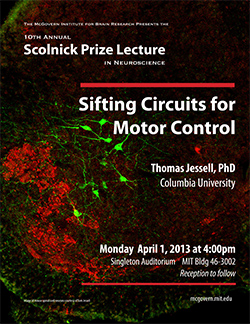
 Dr. Thomas Jessell is a developmental neurobiologist at Columbia University Medical Center and the latest recipient of the Scolnick Prize in Neuroscience, which includes a $100,000 award. In the Jessell Lab in the Hammer Health Sciences Building, researchers study the vertebrate central nervous system to understand how neurons become encoded at the embryonic level, particularly in the spinal cord. The Scolnick Prize singles out Jessell's work for identifying signaling molecules and transcriptional code that establish a linkage between functional circuitry and motor behavior. Also a member of Columbia's Motor Neuron Center, which is dedicated to the study of motor neuron diseases like ALS, Dr. Jessell is a faculty member in the Department of Biochemistry and Molecular Biophysics, a Howard Hughes Medical Institute investigator, and part of the larger Columbia Neuroscience interdisciplinary research community. He will travel to Boston in April to accept the prize and deliver a lecture (see image at right). The Scolnick Prize is given out by the McGovern Institute for Brain Research at MIT. According to McGovern chairman Robert Desimone, from a recent CUMC press release:
Tags: 2014, 2013, Northeast, Scolnick Prize, New York, Columbia University, Neuroscience, Columbia, BioResearch Product Faire Event, Research, Stem Cell, New York City, Columbia University Medical Center, Northeast Region, lab supplier, NYColumbia University
Biotechnology vendors and lab suppliers in Minnesota will find a well-funded life science research market at the University of Minnesota, Twin Cities, according to the most recent NIH and NSF research funding statistics. In 2012, the NIH awarded the University of Minnesota, Twin Cities $243.5 million in research funding. The funding was distributed among a number of different departments at the university. For the convenience of our readers, we have composed a list with the number of projects awarded money in each science research discipline and the total amount of funding for those projects:
Tags: 2014, Midwest, 2013, University of Minnesota, Minnesota, University of Minnesota Twin Cities, biotechnology vendors and lab suppliers, BioResearch Product Faire Event, Research Funding, NIH, Life Science, science research, Minneapolis, MN, NSF, lab suppliers, St.Paul, UMinn
North Carolina appears to have a rich life science sales market when taking into account recent life science funding statistics. North Carolina Biotechnology Center in particular gave $2.9 million in loans and grants to life science companies and researchers during this second fiscal quarter. North Carolina Biotechnology Center has been funding life science researchers and startups since 1984, helping to make North Carolina the third largest biotechnology cluster in the United States. Ten different programs received awards based on entrepreneurship, technology and education. North Carolina now hosts over 500 life science companies and 58,000 employees who earn an average salary greater than $78,000.
Tags: 2014, 2013, University of North Carolina at Chapel Hill, Duke University, North Carolina, University of North Carolina, Life Science Funding, Southern, BioResearch Product Faire Event, Durham, Front Line event, NIH, NC, Front Line, Chapel Hill, Duke, NSF, UNC, UNC-Chapel Hill, lab supplier, Life Science Sales, North Carolina Biotechnology Center
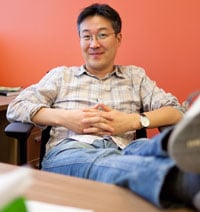 The tighter funding gets, the more likely it is that young investigators pursuing big ideas will get passed over and science grant money will stay with safer, more established projects. Fortunately there are exceptions to that general rule, including a new program established by the Paul G. Allen Family Foundation specifically to support select pioneering research projects that aim to unlock fundamental questions in biology. They recently awarded investigators from 5 prestigious US universities a total of $7.5M to pursue basic questions about the origins and mechanisms of cellular behavior. One of those 5 Distinguished Investigator awards, for $1.6M, is going to quantitative biologist and recent hire Suckjoon Jun, who works in physics and molecular biology at the University of California San Diego. His project title is "Cell-size control and its evolution at the single-cell level," and includes developing methods to perform long-term directed single-cell evolution experiments, as well as single-cell on-chip manipulation, sequencing, and mathematical modeling.
Tags: 2014, CA, University of California San Diego, 2013, cell biology, Southwest, California, University of California, Cell Research, San Diego, SDVS, Funding, UCSD, Biotechnology Vendor Showcase
A microscopic worm by the name of Schistosoma mansoni has been long credited with a long lifespan and an uncanny knack for regeneration. Thanks to recent research from the University of Illinois at Urbana-Champaign, the worm’s secret is out: it utilizes adult stem cells to restore and replace itself at will.
Tags: 2014, Midwest, 2013, University of Illinois, University of Illinois Urbana-Champaign, Urbana-Champaign, Illinois, UIUrbana, BioResearch Product Faire Event, Stem Cell, IL, parasite, laboratory product, UI Urbana
Lab scientists at the University of Pittsburgh Cancer Institute and UP's Center for Biologic Imaging have recently published an important paper in the Journal of Cell Science that sheds light on a novel method of interrupting mitosis in a cell by effectively depriving its mitochondria of a key protein. The resulting replication stress means cancer cells are stopped from successfully multiplying. Colorful images of the targeted cells actually show them stuck in anaphase trying to divide and subsequently tearing themselves apart. By identifying a compound that carries out this protein interference and disrupts normal mitochondrial fission, researchers have identified a promising therapeutic avenue for halting cancer growth.
Tags: 2014, 2013, University of Pittsburgh, Pennsylvania, Northeast, Hillman Cancer Center, cancer research, cell biology, Microscopy, UPITT, Cell Research, BioResearch Product Faire Event, PA, NIH, Pittsburgh, Northeast Region
Emory University recently received research funding for the Winship Cancer Institute totaling $10 million from the Wilbur and Hilda Glenn Family Foundation. The gifts will fund the Glenn Family Breast Center at Winship and will be directed towards supporting the breast cancer program’s research goals in Georgia, such as funding clinical trials and recruitment. According to an Emory University news article, the Glenn Scholars program, which donates research money to Winship scientists whose breast cancer research has a high impact, will also benefit from the research funding.
Tags: 2014, Emory University, 2013, Winship Cancer Institute, cancer research, Southern, Georgia, Emory, BioResearch Product Faire Event, Research Funding, Atlanta, GA, lab supplier, Southern Region, Cancer Center, charitable giving, research money
 Since its first lemonade stand was set up in 2000 by a little girl with cancer, the Alex's Lemonade Stand Foundation (ALSF) has raised over $60M to support pediatric cancer research at institutions across the United States. That's a lot of lemonade. While lemonade stands are still a staple of the organization's activities, celebrity support and large fund raising events like the recent "Lemon Ball" (which raised a record $825K) allow ALSF to leverage the kind of funds that really make a difference. In a recent round of funding awards, the University of California San Francisco's Benioff Children's Hospital was named a Center of Excellence by the foundation and given $1.75M to speed translational research programs and training over the next five years. Chief investigator on the grant is Dr. Katherine Matthay, chief of pediatric oncology at Benioff. She says of the ALSF award in a recent news release:
Tags: 2014, CA, University of California San Francisco, 2013, University of California San Francisco Mission Bay, University of California San Francisco Parnassus, cancer research, Southwest, California, University of California, Pediatric Cancer Research, San Francisco, SFVS, BioResearch Product Faire Event, Funding, San Francisco cancer research, Biotechnology Vendor Showcase, UCSF, Parnassus, Mission Bay, Benioff Children's Hospital
When it comes to identifying the onset of Alzheimer’s disease, every minute counts. Often it’s not even possible to determine whether a person is afflicted with it until it’s too late: that is, once symptoms start to show. A promising study at the University of Wisconsin, Madison suggests that there exists a way to diagnose Alzheimer’s before the onset of symptoms, not after.
Tags: 2014, Midwest, 2013, WI, Wisconsin, University of Wisconsin, University of Wisconsin Madison, UWiscRP, UWisc, University of Wisconsin Research Park, UW Madison, Alzheimers, BioResearch Product Faire Event, laboratory, Front Line event, lab, Madison, Front Line, lab supplier, researcher
The University of Wisconsin-Madison is a richly-funded science research environment, which is especially evident given recent NSF and NIH research funding statistics. In total, the University of Wisconsin-Madison received $335.9 million in research funding from the NSF and NIH in 2012. The NSF awarded the university $106 million. Of that money, $13.8 million went to bio research projects alone. For our readers’ convenience, we have spotlighted the top five NSF-funded bio research projects broken down by funding program, project title and research funding below.
Tags: 2014, Midwest, 2013, UW, WI, Wisconsin, University of Wisconsin, University of Wisconsin Madison, UWiscRP, UWisc, University of Wisconsin Research Park, UW Madison, bio research, BioResearch Product Faire Event, Research Funding, Front Line event, Madison, Front Line, NIH funding, NSF funding