

While the NASA rover Curiosity explores the Martian surface, researchers from Washington University at St. Louis (WUSTL) are working behind the scenes, exploring the data that the rover sends back. WUSTL researchers also played a large part in getting Curiosity off the ground, literally.
Read More
0 Comments Click here to read/write comments
Tags: Midwest, Washington University, Missouri, WUSTL, 2012, BioResearch Product Faire Event, MO, St Louis
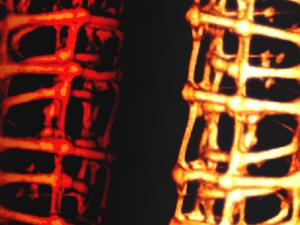 It's getting to the point where there's less and less relevant distinction to be made between life science and physical science research. It was clearer when one lab had petri dishes and the other had circuitboards, but what happens when you have both? That's the case in the Harvard University labs of chemist Charles Lieber and his medical school colleague Daniel Kohane, where the bio research team has successfully created living tissue embedded with tiny nanowires capable of running an electrical current so subtle that it does not harm the tissue cells. These 3D bioelectronic structures could potentially both relay complex information about what's going on inside the tissue and receive signals from an outside source such as instructions for repairs. Several news outlets are calling it cyborg tissue and envision its future use in implants, prosthetics, or even some kind of therapeutic microbot. More immediately it will most likely be used for drug testing in labs, as a precursor to animal or human trials.
0 Comments Click here to read/write comments
Tags: Northeast, MIT, cell biology, 2012, Biochemistry, Massachusetts, biorobotics, Cell Research, chemistry research, bioprinting, Boston, BioResearch Product Faire Event, MA, Harvard, Harvard Medical School
A research team composed of researchers from the University of Colorado at Boulder and Yale University recently released a public demonstration of their Map of Life, a database that stores the geographic locations of the world's species. The demonstration version contains about 25,000 different species of birds, mammals, reptiles, amphibians and fish to date, but the goal is to have a complete record for every living organism on Earth.
0 Comments Click here to read/write comments
Tags: University of Colorado, Bioinformatics, Southwest, 2012, animal science, BioResearch Product Faire Event, CO, Boulder, UCO
The University of Georgia’s Health Sciences Campus (GHSU) recently opened for its first year on August 6th. The new campus will house two principal occupants: the College of Public Health and the GHSU/UGA Medical Partnership. According to the Athens Patch, land for the campus came from the U.S. Navy Supply Corps School, which closed in 2005 and was purchased by UGA in 2007.
0 Comments Click here to read/write comments
Tags: University of Georgia, 2012, Georgia, UGA, BioResearch Product Faire Event, Athens, GA, Health Sciences Campus
If your company is an active participant in the research science marketplace, you can take this opportunity to reserve space in upcoming 2013 events being held at top funded science markets nationwide.
2 Comments Click here to read/write comments
Tags: Biotechnology Calendar, 2012, BioResearch Product Faire Event, Front Line event, bioscience event, Biotechnology Vendor Showcase, special pricing, product show
The Clinical & Translational Science Center (CTSC) headquartered at Manhattan's Weill Cornell Medical College has just received a $49.6M renewal of its 5-year grant by the NIH's National Center for Advancing Translational Sciences (NCATS) in order to continue its work. Launched seven years ago, the the CTSC set out to realize the successful integration of inter-institutional resources among neighbors on York Avenue and the immediate area. The resulting cluster of New York's East Side institutions forms a unique and cohesive biomedical complex collectively dedicated to accelerating the clinical application of basic science discoveries.
0 Comments Click here to read/write comments
Tags: Rockefeller University, Northeast, Translational Research, New research facilities, new science wet labs, New York, Columbia University, 2012, Weill Cornell, Columbia, MSSM, RockU, BioResearch Product Faire Event, Funding, NY, NIH, Stoneybrook, SunySB, NYC campus competition, Mt Sinai School of Medicine
Given that the ubiquity of sweat glands over the surface of the body is such a defining aspect of human physiology (and evolution), it's a wonder how little basic research has been done to understand how they work at the cellular level. Until Rockefeller University cell biologists published their recent findings in Cell, we didn't even know if sweat glands had unique stem cells. It turns out they do. The study also demonstrated that, while sweat glands are close cousins to mammary glands, adult stem cell activity is markedly different in the two systems (though they have a common progenitor), and in fact that there are four separate stem cell types that regulate maintenance and repair of glands and their epidermal-level counterparts throughout our lives.
0 Comments Click here to read/write comments
Tags: Rockefeller University, Northeast, Stem cell research, cell biology, New York, 2012, Cell Research, bio research, BioResearch Product Faire Event, NY, New York City
The Washington-based Pacific Northwest Prostate Cancer SPORE (Specialized Programs of Research Excellence) is a cutting-edge life science consortium which includes several research centers throughout Washington State and British Columbia. The consortium focuses on the genetic mechanisms of prostate cancer to better develop effective treatments for the disease.
2 Comments Click here to read/write comments
Tags: Fred Hutchinson Cancer Research Center, UW, University of Washington, WA research, 2012, Washington Life Science, washington life science consortium, BioResearch Product Faire Event, Front Line event, NIH, Seattle, research grant
Physics and nanotechnology research at the University of Minnesota has outgrown its 80-year old facility and prompted the construction of the 144,000 sf state-of-the-art building that is now rising on campus. (See the live webcam footage.) The previous home to the Physics Department, the Tate Laboratory, can no longer support the advanced research carried out by more than 150 faculty and graduate students there, nor is it adequate for a field (nanotechnology) that has only relatively recently come into being. The new $83M lab research facility will allow the physics and nanotechnology departments to move forward in this century as well as join forces in collaborative research projects.
0 Comments Click here to read/write comments
Tags: Midwest, nanotechnology, New research facilities, Minnesota, University of Minnesota Twin Cities, 2012, BioResearch Product Faire Event, Research, research laboratories, MN, new construction, BRPF, Minn, Twin Cities
By now you've probably heard about 3D bio printing, a bioengineering technique for literally building functional replacement tissue and eventually organs. (Read an earlier blog of ours on the subject.) While still in the early stages of development in terms of actually producing a human organ for transplant, the technology is advancing and critical problems are being met with innovative solutions. In the July issue of Nature Materials, University of Pennsylvania scientists, in conjunction with MIT and Harvard researchers, published an article documenting their success creating a blood vessel network using sugar.
0 Comments Click here to read/write comments
Tags: Pennsylvania, Northeast, University of Pennsylvania, UPenn, 2012, Cell Research, bioprinting, bio research, Philadelphia, BioResearch Product Faire Event, Research, Front Line event, PA, BRPF, scientist solutions, science solution