

Until recently, nerve damage has been considered irreparable and impossible to treat. Only now are we seeing breakthroughs in nerve care such as Washington University’s study on preventing axon degeneration and UC Irvine’s study on regenerating nerves with salmon protein. Taking things one step farther, a University of Minnesota, Twin Cities research group has developed a method to foster nerve regrowth using 3D printing.
Read More
0 Comments Click here to read/write comments
Tags: University of Minnesota Twin Cities, 2015, BioResearch Product Faire Event, MN, UMinn, Twin Cities
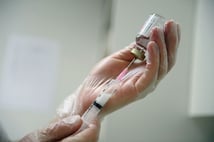 The flu is something that everyone experiences at some time. Even after receiving an annual flu shot, many people still fall ill due to a different strain of the flu that the shot does not protect against. Generally, the flu shot protects against three common strains of influenza, leaving people still vulnerable to getting the flu. Researchers at Rockefeller University have developed a new method of creating the flu vaccine that could potentially work against many more strains of influenza. (Image courtesy of Wikimedia Commons).
0 Comments Click here to read/write comments
Tags: Rockefeller University, Northeast, influenza research, New York, 2015, RockU, BioResearch Product Faire Event, NY
Though there is currently no known cure for human immunodeficiency virus (HIV), bioscientists at research universities across the globe are looking into ways to mitigate the disease. In our country, we’ve recently seen St. Louis researchers use bee venom to puncture HIV viruses and Twin Cities researchers investigate a genetic immunity to HIV. At Michigan State University, a team has discovered an inhibitor to the virus that is found inside the human body.
Read More
0 Comments Click here to read/write comments
Tags: Michigan State University, 2015, BioResearch Product Faire Event, MI, East Lansing, MSU
A rational approach to tackling diabetes using life science research is to focus on insulin. We’ve seen a research team at Emory University transplant insulin-producing cells, and we’ve reported on an Urbana-Champaign team trying to release insulin in patients’ cells. Now researchers at Washington University at St. Louis are taking a new approach by directly reducing blood sugar without the use of insulin.
 Brian Finck (image left, courtesy WUSTL) believes that rather than rely on insulin to lower blood sugar in patients with diabetes, it’s easier to cut out the middle man and reduce glucose levels using genetics. He and fellow WUSTL professor Kyle McCommis found that shutting down a particular liver protein dramatically reduced glucose production in the liver.

“We think this strategy could lead to more effective drugs for type 2 diabetes,” says Finck, who is an associate professor of medicine in the Division of Geriatrics and Nutritional Science. “A drug that shuts down glucose production has the potential to help millions of people affected by the most common form of diabetes.”
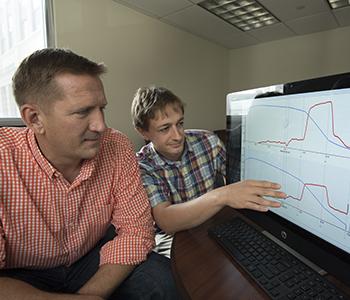
(Brian N. Finck, PhD (left), and Kyle S. McCommis, PhD analyze blood sugar levels to evaluate their new strategy. Image courtesy WUSTL)

The team has already initiated clinical trials using the drug compound MSDC-0602. So far, the drugs have been successful in inhibiting the protein and reducing blood sugar levels. Dr. Finck is working with the biopharmaceutical company Metabolic Solutions Development Co. to facilitate production of the drug.
Funding for this research came from the National Institute of Diabetes and Digestive and Kidney Diseases and the National Institute on Alcohol Abuse and Alcoholism of the National Institutes of Health as well as the Foundation for Barnes-Jewish Hospital and the Robert A.Welch Foundation. For additional information about funding for research at Washington University in St. Louis, read our free WUSTL Funding Statistics Report, available via the link below:
Read More
0 Comments Click here to read/write comments
Tags: WashU, Washington University in St. Louis, 2015, BioResearch Product Faire Event, MO, St Louis
Yeasts are valuable as both tools and allies in the life sciences. We saw how yeast taught Ann Arbor researchers about DNA and showed Urbana-Champaign researchers how to save bats from a deadly disease. Now a team at the University of Michigan at Ann Arbor is learning from yeasts how to slow the onset of another deadly disease, namely cancer.
Read More
0 Comments Click here to read/write comments
Tags: University of Michigan Ann Arbor, 2015, Ann Arbor, BioResearch Product Faire Event, MI, UMich
Bioresearch can help the development of treatment for several eye diseases; for instance, the University of Illinois tackled macular degeneration and the University of Wisconsin developed solar contact lenses to treat the eye disease presbyopia. Now the University of Wisconsin, Madison is studying new solutions to the disease amblyopia, more commonly known as “lazy eye.”
Read More
0 Comments Click here to read/write comments
Tags: WI, University of Wisconsin Madison, UWiscRP, UWisc, 2015, BioResearch Product Faire Event, Madison
Growing human organs outside of the body is more reality than science fiction these days. We have seen researchers reproduce a human heart from bicep muscle cells at the Mayo Clinic in Rochester and grow stomachs and intestines in the labs of the University of Cincinnati. Now The Ohio State University is taking on the challenge of recreating the human brain.
0 Comments Click here to read/write comments
Tags: Ohio State University, 2015, BioResearch Product Faire Event, Columbus, OH, OhStu
 Ribosomes, found within cells, are vital to the production of proteins and enzymes. Researchers from the University of Chicago, Illinois and Northwestern University recently created the first ribosome engineered in a lab. This newly engineered ribosome, named Ribo-T, was found to work almost as well as natural ribosomes found within organisms, leading scientists to see potential uses for new drugs and biomaterials. (Image courtesy of Wikimedia Commons)
0 Comments Click here to read/write comments
Tags: University of Illinois Chicago, 2015, BioResearch Product Faire Event, Chicago, IL, UIChgo, Ribosomes
Innocuous as they seem, fungi can seriously threaten many forms of life. We saw this May how a fungus can destroy soybean crop, and how a UIUC geneticist developed a method to overcome it. Now, another life science researcher from the University of Illinois, Urbana-Champaign is taking up arms against a fungus that threatens the entire North American bat population.
Read More
0 Comments Click here to read/write comments
Tags: University of Illinois Urbana-Champaign, Urbana-Champaign, 2015, UIUrbana, BioResearch Product Faire Event, IL
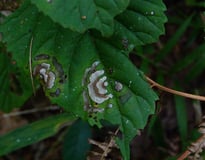 Getting a fungal infection is a part of life, that everyone experiences at one time or another. These types of infections range in seriousness, from athlete's foot to ringworm to histoplasmosis. Although commonly fatal, more than 1.3 million people contract fatal fungal infections each year. Currently, there are three known antifungal drugs available to fight these infections, though they are not always the most effective. (Image courtesy of L. Shyamal via Wikimedia Commons)
1 Comment Click here to read/write comments
Tags: Fungi, New York, 2015, BioResearch Product Faire Event, NY, Stony Brook, SunySB, Fungal Infections