

Science researchers at the University of Texas at Austin have received a $3.3 million, five-year grant from the National Institute on Alcohol Abuse and Alcoholism to work on a medication to treat alcoholism and drug addiction, according to a UT Austin news article. The donating institute is a part of the National Institutes of Health.
Read More
0 Comments Click here to read/write comments
Tags: University of Texas at Austin, Texas, UTAust, alcoholism research, UT Austin, science researcher
Geneticists at the University of Arizona recently worked with 300 research scientists in 14 countries to crack the genetic code of tomatoes. The results of the study are expected to be used to lessen costs of tomato production and improve efforts at making tomatoes resistant to drought and pests. Founded in 2003 in Washington, the Tomato Genome Consortium includes scientists from Argentina, Belgium, China, France, Germany, India, Israel, Italy, Japan, Korea, the Netherlands, the United Kingdom, Spain and the United States. The results of the study were published as a cover story in the May 31 issue of the journal Nature.
0 Comments Click here to read/write comments
A study by researchers at the Fred Hutchinson Cancer Research Center has revealed that a fast DNA sequencing technique called high-throughput sequencing (HTS) can greatly improve cancer relapse detection in patients.
0 Comments Click here to read/write comments
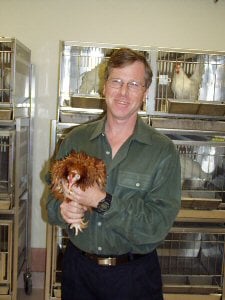 The University of Southern California has a thriving regenerative medicine research headquarters at the Broad Center within the Keck School of Medicine. Established in 2006, the Center's $80M state-of-the-art building opened in 2010 to house eleven research teams and four core laboratories. In addition to seeking out therapeutics, though, a team of USC stem cell scientists is marrying their study of stem cell functioning to a more thorough understanding of regenerative biology as it happens naturally in many species of animal. Drs. Cheng-Ming Chuong, Randall B. Widelitz (right), Ping Wu, and Ting-Xin Jiang of the Department of Pathology discuss their lab research, which looks at stem cells in hair and feathers in particular, in a recent article published in the journal Physiology.
1 Comment Click here to read/write comments
Tags: University of Southern California, Stem cell research, USC Science, Southwest, California, Los Angeles, animal science, biology research, Front Line event
The development of successful vaccinations can be considered among the most important discoveries in medicine. It has caused significant reduction in the occurrence of several major diseases and has virtually eliminated some pathogens such as smallpox. Even with previous developments, there is always the room for improvements.
0 Comments Click here to read/write comments
Tags: Oregon Health Sciences University, vaccine research, OHSU
The Madison Wisconsin has a vibrant and active life science research community that has been growing at an astonishing pace. To keep up with research needs, Madison area researchers have been finding new lab products for their growing research programs at the annual Madison BioResearch Product Fair™ Event. Interested life science professionals can access recent posts about research growth and development in the Madison area here where the following posts are available:
0 Comments Click here to read/write comments
Tags: Bioscience research, vendor shows, Wisconsin, University of Wisconsin Madison, BioResearch Product Faire Event, current science event, bioscience event
The University of California Irvine may be a youngster in the world of great universities (having been established as recently as 1965), but the Southern California campus has not wasted any time distinguishing its research and academic programs. In fact, according to a recent ranking by the UK's Times Higher Education, UC Irvine is #1 in the US and #4 in the world among the Times' Top 100 Universities Under 50 Years Old. The new ranking category was added to specifically look at the merits of campuses that were not old enough to compete with prestigious, long-established institutions in areas like alumni support and "reputation" but nonetheless were strong in research and publications. The 100 Under 50 recognizes current and future promise more than past success, and in that respect UCI is unmatched in the US.
0 Comments Click here to read/write comments
Tags: CA, biomedical research, Stem cell research, Southwest, BioResearch Product Faire Event, Funding, Irvine, CIRM, UCI, UC Irvine
You've heard the phrase "a force of nature," but we'd have to say that the University of Pittsburgh is clearly a force of science based on several recent news items: the University ranks in the Top 3 among public institutions of higher learning in the US (according to the NSF); they're in the Top 5 in federally financed research and development expenditures; and they've just had 3 of their faculty scientists elected to the prestigious National Academy of Sciences. Chancellor Mark Nordenberg says of the first honor:
0 Comments Click here to read/write comments
Tags: University of Pittsburgh, Northeast, BioResearch Product Faire Event, scientific events, Pittsburgh, NSF, BRPF
0 Comments Click here to read/write comments
Tags: Georgetown University, Washington DC, Northeast, Multiple Sclerosis, new science wet labs, 2012, Neuroscience, Geotwn, BioResearch Product Faire Event, Biomedical Research Funding, charitable giving
UC Riverside, once considered by some as the poor cousin to more established UC's, is now a thriving beehive of growth and activity in the areas of biomedicine and life science research. UC Riverside has always been strong in agriculture, business, and engineering; but UC Riverside had lacked the prestige that comes with being a medical training center, until now. With a new medical faculty, a new medical school, new buildings, and new research programs, UC Riverside is on its way to becoming a world class research institute in the medical science field; a title previously reserved for its rich cousin's in Southern and Northern California.
0 Comments Click here to read/write comments
Tags: University of California Riverside, Medical Research, Stem cell research, Southwest, California, Funding, research laboratories, UC Riverside, science research funding