

On October 21, President Obama presented the National Medal of Science awards to the 2011 recipients in a ceremony at the White House. The award program is administered for the White House by the NSF to recognize individuals who have made outstanding lifetime contributions to science and engineering.
Recent Posts
Read More
0 Comments Click here to read/write comments
Tags: University of California San Diego, Pennsylvania, Utah, university of utah, University of Pennsylvania, California
0 Comments Click here to read/write comments
Tags: Texas Medical Center, Texas, Southwest, University Research, tmc
By now it is clear that the big funding compromise the congressional supercommittee hoped to hammer out together has failed to come into being, meaning that automatic, across-the-board spending cuts for federal discretionary programs will go into effect. The probable result for the NIH's portion: cuts between 5-10% each year for the next 10 years. Will the President try and intercede? He says No. Are people happy with Congress' performance after this bipartisan failure? Decidedly not: NPR reported over the weekend that Congress' approval rating is at an all-time-low of 9%. Students, researchers, professional and industry organizations, and universities with vital bioscience programs especially are continuing to be very vocal about the pending funding cuts. We wait to see if and where the axe will fall exactly, though complacency is not the order of the day. Everyone seems to agree that the US needs to maintain its edge internationally as a leader in science and technology, but how to do that while reducing the deficit is a problem still without an equitable solution.
0 Comments Click here to read/write comments
Tags: 2012 Research Funding, NIH, NSF
0 Comments Click here to read/write comments
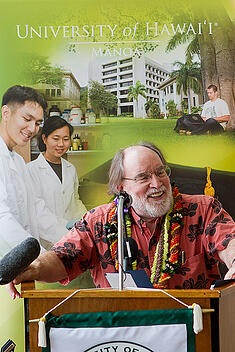
Tags: 2012 Research Funding, University of Hawaii, 2012, BioResearch Product Faire Front Line Event, HI, 2011, Manoa
Dr. Cynthia Kenyon and her colleagues at the University of California, San Francisco, started on an ambitious project two decades ago (much challenged at first): to combat age-related diseases by figuring out what the genetic basis is for aging itself. That research has produced results that have quite literally changed the terms of the debate, overturning the previous assumption that aging was haphazard and unrelated to genetic behavior. Thanks to Dr. Kenyon's determination to pursue her research, we now have several enticing keys to the way that bodies get old, or not, and we know that genes do in fact regulate the process of deterioration that tends to accompany aging. "Aging youthfully" might best describe the longterm aim of Kenyon's work, or "negligible senescence," meaning that age does not lead inevitably to decreased vigor and increased susceptibility to disease.
2 Comments Click here to read/write comments
Tags: University of California San Francisco, gene therapy, California, UCSF
As early as February of 2012, project organizers plan on opening the New York Genome Center, a new center for genomics and medicine, in Manhattan. NYGC’s collaborating members include a number of public and private contributors, among them 11 academic institutions, private philanthropists, technology collaborators, the New York City Economic Corporation and the New York City Investment Fund. In total, contributing members have donated $120 million to the project so far.
0 Comments Click here to read/write comments
Tags: Mount Sinai School of Medicine, Rockefeller University, Northeast, Cornell University, genomic research, genome research, genomic medicine, Columbia University, Genomics
The Emory School of Medicine has launched a new Biomedical Informatics Department. The new department will create more faculty positions and will help encourage opportunities for improved training, education and research in this emerging field.
0 Comments Click here to read/write comments
Tags: Emory University, Southeast, Georgia, Biomedical Research Funding
Stem cells are remarkable for the promise they hold to regenerate diseased or otherwise compromised organs and tissue in the body. At the University of Texas Health Science Center in San Antonio, researchers at the Barshop Institute of Aging and Longevity Studies are particularly focused on how a patient's own stem cells can be used to treat degeneration caused by aging, such as bone loss. Proprietary cells (i.e. ones from your own body) are the best biological match for therapies to treat you, but the problem is that they're too mature and therefore much less effective than young cells in transforming themselves into new and useful parts. Some people have begun to bank cells from birth, such as those from the umbilical cord, for a child's future need. For the rest of us, there is the very real possibility of coaxing our own older stem cells into a more youthful, robust, and potent state by growing them on a younger scaffold.
0 Comments Click here to read/write comments
Tags: Aging, Stem cell research, Texas, Southwest, UT Health Science Center San Antonio
 By now you've probably heard of "lab-on-a-chip" technology, where engineers take a lab analysis process that once required, well, a lab, and make it possible to run that analysis on a handheld smartphone device. Results are generated in real time, cheaper, and without bulky equipment. In this case, Michigan State University (MSU) plant pathologists are using the device in a field of vegetables under attack by pathogens.
0 Comments Click here to read/write comments
Tags: Michigan State University, Midwest, Lab-on-a-chip Technology, Michigan, Plant science
 Last year, Fred Hutchinson Cancer Research Center in Seattle acquired a newly-constructed 177,000 sf building adjacent to its campus on South Lake Union for $36Million. The complicated business of moving all of the Vaccine and Infectious Disease Division (VIDD) labs and faculty from their current building(s) into the new space is scheduled for June of 2012. While there will be an overall increase in lab square footage, the main advantages of the relocation involve building quality, location, and financial benefits.
1 Comment Click here to read/write comments
Tags: Fred Hutchinson Cancer Research Center, Washington, Northwest, cancer research, New research facilities, Event