

Depending on who you ask, antibiotics are the best and worst defense against disease-bearing bacteria. On the one hand, they are very effective and easy to administer. Unfortunately, the more we use them, the more bacteria learn to thrive in a so-called “antibacterial” environment, culminating in a worst-case scenario where all bacteria are entirely resistant to antibiotics. Fighting against that future are bioresearchers from the University of Illinois, Chicago, who are pursuing more clever ways to prevent microbes from diseasing us.
Read More
0 Comments Click here to read/write comments
Tags: 2014, Midwest, 2013, University of Illinois, University of Illinois Chicago, Illinois, BioResearch Product Faire Event, Chicago, IL, UI Chicago, UIChgo
The University of California, San Francisco was recently ranked number two in the country for receiving biomedical research grants from the NIH, and it was also the number one ranked public school in the country for receiving these grants. According to the University of California, San Francisco news page, this funding allows UCSF researchers to undertake groundbreaking studies that aim at a better understanding of cancer, diabetes, HIV, Parkinson’s, Alzheimer’s and cardiovascular disease.
1 Comment Click here to read/write comments
Tags: 2014, CA, University of California San Francisco, 2013, University of California San Francisco Parnassus, Southwest, California, San Francisco, SFVS, Biotechnology Vendor Showcase, UCSF, UC San Francisco, Parnassus
Each year, Biotechnology Calendar, Inc. hosts over 55 BioResearch Product Faire™ events and 4 Biotechnology Vendor Showcase™ events all across the US. Of these shows, we have three BioResearch Product Faire™ Events in the state of Oregon: on the campuses of the University of Oregon, Oregon State University, and the Oregon Health and Science University.
0 Comments Click here to read/write comments
Tags: 2014, 2013, Oregon State University, Oregon Health and Science University, UOr, Northwest, University of Oregon, Oregon, BioResearch Product Faire Event, Life Sciences, Front Line event, Front Line, Corvallis, Eugene, OHSU, Portland, Bioresearch Equipment, ORSTU
Researchers at Columbia University recently conducted a study aiming to identify an Alzheimer’s gene in African-Americans. The results were published in the April 10 issue of the Journal of the American Medical Association, and the study was funded by NIH research grants. African-Americans with the ABCA7 gene have almost twice the amount of risk of developing late-onset Alzheimer’s disease. According to a Columbia University news article, the gene is involved in producing cholesterol and lipids, and researchers believe that lipid metabolism may be a key pathway in Alzheimer’s disease in African-Americans, more so than it may be in white people.
0 Comments Click here to read/write comments
Tags: 2014, 2013, Northeast, New York, Columbia University, Columbia, BioResearch Product Faire Event, NY, New York City
On May 2nd, 2013, a very important addition to the WSU Pullman campus was dedicated. The Veterinary and Biomedical Research Building (VMRB) is now the seventh connected building in the WSU Research and Educational Complex. This new building will foster research relating specifically to biomedical questions revolving around human and animal health.
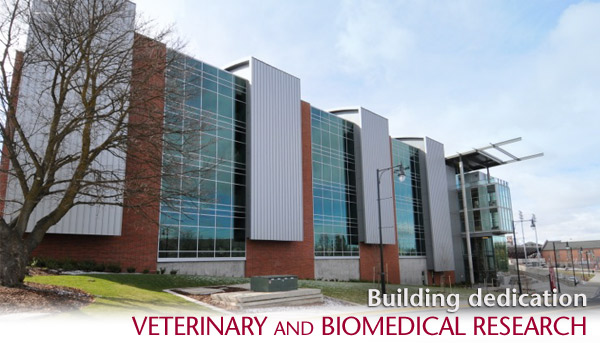
This development has been under construction since August 2010 and is the most newly added member to the Research and Educational Complex on the WSU Pullman campus. This $96 million dollar investment by WSU will focus on many health issues including:
- Heart health: How, by uncovering the biophysical mechanisms of cardiac muscle contraction, new discoveries into cardiac function and disease can be revealed.
- Emotional health: How understanding the basis of emotions of companion and production animals can improve the lives of people with affective disorders.
- Sleep and circadian rhythms: How rhythms, dysrhythms, and circadian biology affect animal biology and can improve and inhibit daily functions in animals and people.
- Neurological diseases: How neurodegenerative diseases, such as Parkinson’s disease, can be treated more effectively by discovering the underlying causes and subsequently creating treatments to repair the loss of functionality.
- Obesity and Diabetes: How obesity and diabetes can be prevented by studying and understanding the relationship between the consumption of food and how energy is consequently regulated into the body.
- Drug addiction: How the biological actions of commonly abused drugs can be used to reverse the destrctive nature of addiction and help prevent the relapses of drug users.
This research facility is operating east of the Martin Stadium entrance and south of the Beasley Coliseum parking lot. This building boasts 77,250 net square feet (128,000 gross square feet) of state-of-the-art space, highly suitable for biomedical research, health science teaching, and research programs. Also included in this structure is a vivarium (an indoor facility for safely housing animals and plants in their natural environments for humane scientific observation), which will allow for gene targeting of the animals and provide necessary quarantined space to guarantee uncontaminated research. These labs and offices were specifically designed with the Veterinary Medicine Department of Integrative Physiology and Neuroscience in mind.
On the subject of this exciting new development, WSU regent Scott Carson remarks, “This building is the beginning. It’s our opportunity to compete for those wonderful young people that will be coming here in the future - the researchers that will do wonderful work because of the collaborative environment that this represents.”
Washington State University’s College of Veterinary Medicine (CVM) is one of the top leaders in research benefiting to animal and human health and well being. In fact, solely during the 2006 fiscal year, the research faculty placed the CVM well into the top tier of all veterinary schools by working with over $12.5 million in competitively funded research.
Some of these specialized areas are:
*Food & water-borne diseases
*Cardiovascular medicine & physiology
*Immunology and infectious diseases
*Neurobiology
*Microbial genomics and proteomics
1 Comment Click here to read/write comments
Tags: 2014, 2013, biomedical research, Washington, WSU Pullman, WA, Northwest, WA research, WSU, Washington State University, Washington Life Science, BioResearch Product Faire Event, buiding. new building, research science information, Biomedical Research Funding, Pullman
Science researchers at the University of Pittsburgh recently published a study that found that patients suffering from SAD – Seasonal Affective Disorder – had misconceptions about sleep similar to those of insomniacs that prevent them from sleeping soundly at night. According to a University of Pittsburgh news article, the paper was titled “The Role of Beliefs and Attitudes About Sleep in Seasonal and Nonseasonal Mood Disorder, and Nondepressed Controls” and was published in the Journal of Affective Disorders this May.
1 Comment Click here to read/write comments
Tags: 2014, 2013, University of Pittsburgh, Pennsylvania, Northeast, UPITT, BioResearch Product Faire Event, PA, Pittsburgh
As the gardeners and farmers among us tend to their summer crops, a thriving community of gardeners is busy beneath our feet. As rushed and single-minded as ants seem to be, some of them are maintaining gardens of fungi at this very moment. Bioresearchers at the University of Wisconsin, Madison are taking note of these miniature horticulturalists and how their curious habits might aid humans in their search for sustainable energy sources.
0 Comments Click here to read/write comments
Tags: 2014, Midwest, 2013, WI, University of Wisconsin, university research park, UWisc, BioResearch Product Faire Event, Madison
Science researchers at Duke University recently conducted a study that found that patients with a high genetic risk of asthma were 36% more likely to develop severe life-long asthma than those who are not genetically at risk. The researchers said, however, that the research is still in its early stages and not yet ready as a reliable clinical test.
0 Comments Click here to read/write comments
Tags: 2014, 2013, Duke University, North Carolina, Southern, BioResearch Product Faire Event, Durham, NC, Duke
Science researchers at the University of Georgia, the Charlie Norwood VA Medical Center in Augusta and the Georgia Regents University have discovered a direct relationship between Alzheimer’s disease symptoms and two specific antibodies. The discovery may lead to a much-anticipated diagnostic blood test for the disease. The research team published their findings in the Journal of Gerontology: Medical Sciences and found that as two specific proteins’ concentration increases, dementia also increases.
1 Comment Click here to read/write comments
Tags: 2014, 2013, University of Georgia, Southern, Georgia, UGA, BioResearch Product Faire Event, Athens, GA
Science researchers at Harvard University have discovered a gene found in the most devastating forms of cancer that controls embryonic stem cell self-renewal. The gene, SALL4, enables stem cells to keep dividing rather than grow into mature cells. The gene is re-expressed in almost all cases of acute myeloid leukemia and between 10 to 30 percent of lung, ovarian, gastric, liver, breast and endometrial cancer. Researchers say they can make a strong case that the gene plays a part in tumor formation. The breakthrough marks the beginning of a search for a drug that can block the gene’s activity.
1 Comment Click here to read/write comments
Tags: 2014, Harvard University, 2013, Northeast, Massachusetts, Boston, BioResearch Product Faire Event, Cambridge, MA, Harvard