
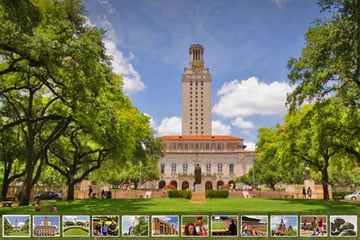
 We're very pleased to announce the newest addition to the Biotechnology Calendar, Inc. Front Line Event Calendar: on November 2 of this year (2011) we will hold our 1st Annual BioResearch Product Faire show on the campus of the University of Texas at Austin (UTA). Front Line events have been extremely popular since we introduced them in 2010 as an alternative to our larger expositions, typically for a special request venue or a more targeted audience. In the case of UT Austin we're venturing onto a campus without a medical school (yet), though that hasn't prevented the University from being a huge recipient of federal research grants.
0 Comments Click here to read/write comments
Tags: University of Texas, Southwest, UTAustin, BioResearch Product Faire Front Line Event, Austin, Life science marketing opportunity, TX, 2011
The research involved in measuring infant cognitive ability over the past two decades has clearly demonstrated that babies only a few months old have a solid, basic grasp on the physicalities of the world. Now, MIT's Josh Tenenbaum has co-led a team of international researchers to explore how infants can use that knowledge to form incredibly surprising expectations of how certain new and unfamiliar situations will turn out.
0 Comments Click here to read/write comments
Tags: Northeast, MIT, infant cognizance, Massachusetts
Case Western Reserve University School of Medicine scientists have identified a protein, SAMHD1, that may inhibit the body's immune response system. This finding represents large gains in the way molecular biology understands immunodeficiency.
0 Comments Click here to read/write comments
Tags: Midwest, Ohio, biomedical research, Case Western Reserve University School of Medicine

With "life sciences" and "physical sciences" occupying distinct areas of thought within science as a whole, it is sometimes easy to forget the ways in which they inform each other. Not so at North Carolina State University, where researchers from the Department of Physics have solved a key puzzle for Parkinson's Disease research.
The project, undertaken with funding assistance from the National Science Foundation and the United States Department of Energy, sought to explain how copper interacts with a key protein to cause misfolding in Parkinson's patients, thought to be a crucial element in the development of the disease. While researchers have long established the link between copper and misfolding, Frisco Rose, Ph.D. candidate at NCSU and lead author of the corresponding paper, explained, "We didn't have a model for what was happening on the molecular level...we wanted to find the specific binding process that leads to misfolding."
0 Comments Click here to read/write comments
Tags: Medical Research, Southeast, NC, National Lab
Once upon a time realizing university officials really wanted to know where students were congregating and what they were doing together had an ominous ring, but that's all changed in the super-connected, GPS-tracked world of today's social media. Internet connectivity no longer means checking in from the vague no-man's-land of cyberspace: with the smartphones almost everyone now has (at least the Gen Y set), you are constantly locatable in real space through the geo-locator technology built into your phone. This geo-social component of social networking offers new possibilities for interacting with places as well as people, and leaving a market-opportunity-rich breadcrumb trail while you're at it.
0 Comments Click here to read/write comments
Tags: vendor shows, Event, industry news, National, marketing, iPhone app
Research by the University of Utah and Omica, Inc. reveal a new computational biology software tool that could dramatically change the way genetic diseases are detected. Published in Genome Research, the Variant Annotation, Analysis and Selection Tool (VAAST) can identify disease causing mutations in individual human genomes.
0 Comments Click here to read/write comments
Tags: cancer research, Southwest, south west, Univ of Utah
UCSD Health Sciences just announced that it will partner with Pfizer to speed delivery of new treatments to market. Pfizer has been successful with its Centers for Therapeutic Innovation (CTI) program at other major research universities, in part because of a non-traditional collaborative approach that includes constant transparency, meaning that they will share resources and information at all stages of research. What each side brings to the table:
0 Comments Click here to read/write comments
Tags: University of California San Diego, Translational Research, California, Southwest Region
The University of Kansas has received a $90,000 research funding grant from the National Science Foundation to conduct groundbreaking research into liver regeneration.
0 Comments Click here to read/write comments
Tags: Midwest, Kansas, University of Kansas, Research Funding
Construction has begun for the third phase of UW Medicine’s research hub in Seattle’s South Lake Union neighborhood. This new building project is part of a major expansion of UW Medicine's research facilities by the development company Vulcan Real Estate.
0 Comments Click here to read/write comments
Tags: Washington, University of Washington, Northwest, New research facilities