

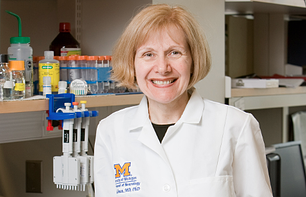
 Until November of 2008, the State of Michigan had some of the most restrictive laws in the country governing stem cell research. Dr. Eva Feldman of the University of Michigan went to California on a grant from philanthropist/benefactor Alfred Taubman to do her stem cell research toward treatment of Lou Gehrig's disease. Then Michigan voters passed Proposal 2, allowing researchers to use human embryonic stem cell lines derived from surplus fertility clinic embryos. After a year debating the ethical and legal angles of this new stem cell opportunity, UM came out with guidelines to direct and permit its researchers to move forward using cells from surplus blastocysts. Dr. Feldman returned to UM, where she is Professor of Neurology and currently conducting the first human trial of a stem cell treatment for Lou Gehrig's disease. [Photo of Dr. Feldman courtesy of Michigan Research Corridor]
Tags: University of Michigan, Midwest, Stem cell research, Michigan, Ann Arbor
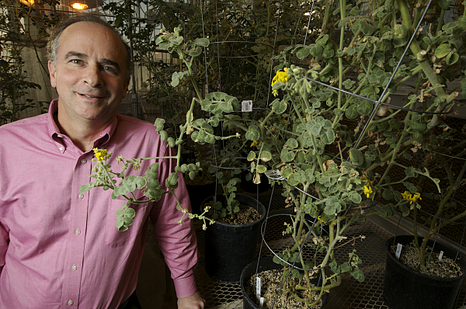
“Plants are amazing biochemists as they make hundreds of thousands of compounds, yet we don’t know how most of these chemical compounds are produced by the plant or the role of these metabolites in the natural history of species across the kingdom.”
Michigan State University professor of molecular biology and biochemistry Robert Last (above photo and quote) and his team of researchers recently received a $4.1M grant from the National Science Foundation to study Andean Tomatoes and the chemicals they naturally produce. Professor Last's research focuses on the tiny hairs on plants, called trichomes that are related to the plant's smell and taste through the sticky, pungent compounds they produce.
Tags: Michigan State University, Midwest, Michigan, Research Funding

Tags: Midwest, University of Cincinnati, brain research, 10th International Functional Foods and Bioactive, BioResearch Product Faire Event, Research Funding, 1 day only, Cincinnati, UCinci
Argonne National Lab and the University of Chicago are pooling their resources with the establishment of UC's new Institute for Molecular Engineering. Researchers at the Institute will explore ways of fabricating and manipulating nanoscale structures to develop new technologies. The germination of the Institute comes from years of molecular research in the basic sciences, both physical and biological, and the desire to craft solutions to real world problems from those scientific insights. The new partnership will benefit not only from the resources of both the National Lab and the University of Chicago, but from the interdisciplinary nature of the Institute's approach to scientific problems.
Tags: Midwest, University of Chicago, BioResearch Product Faire Event, Chicago, IL, molecular research, new construction, UChicago, 2011